

• Dayslong rescue effort: Around 3,000 people are still missing after this week’s catastrophic flash flooding on the Nepal-China border. Nearly 900 Nepali hydropower workers are unaccounted for and may be trapped in remote tunnels.
• Grim toll: More than 670 people have been killed in Nepal and at least seven in China, where official reports have been slow to come out of Tibet. Nepali authorities are struggling to cope with the mounting number of recovered bodies.
• Agonizing wait: Families gather daily at medical centers and morgues to search for information on victims. Loved ones in the US and several other countries await word on missing travelers.
• On the ground: CNN teams have witnessed devastated homes and villages buried in sludge. There’s been no sign of survivors at a Chinese border crossing, where a child’s toy bunny serves as a searing reminder of the families impacted.
CNN’s Anderson Cooper has been reporting from a hospital and morgue in Kathmandu, Nepal, where families are trying to find information on their missing loved ones.
Here’s what we’ve learned on the ground:

How families are searching for missing loved ones in Nepal
CNN's Anderson Cooper reports from a hospital and morgue in Kathmandu, Nepal, where families are searching for information on their missing loved ones. Catastrophic flooding has devastated the region, leaving people scrambling to find victims.
0:42 • Source: CNN

How families are searching for missing loved ones in Nepal
0:42

At least 675 people have been killed in Nepal following convulsive landslides along the Himalayan region on Wednesday, according to Nepali authorities, with thousands more residents missing.
As of Saturday evening local time, another 2,498 people are missing, Nepal’s Disaster Management Authority reported.
The death toll climbed by nearly 50 people over the space of six hours, according to a CNN tally of figures published by local officials. However, that figure is expected to rise even further, as critical rescue and recovery efforts are ongoing.
China’s Foreign Minister Wang Yi noted the “complexity and difficulty” of emergency operations after colossal landslides careened through the Nepal-China border on Wednesday, unleashing catastrophic destruction.
Wang discussed the “serious debris-flow disaster” in a phone call with Nepal’s Foreign Minister Shisir Khanal on Friday, forecasting an “unprecedented” scale of relief efforts in the coming days.
More than 600 people were killed in the disaster, which knocked out Nepal’s burgeoning electricity industry, left hundreds of Nepali employees trapped inside construction sites and tunnels, and thousands more people missing across flood-stricken towns and villages. Nepali people have long-faced earthquakes, floods and landslides — phenomena exacerbated by the human-caused climate crisis.
Both Nepali and Chinese officials will orient recovery efforts around “post-disaster reconstruction, disaster prevention and mitigation, and “response to climate change,” the Chinese ministry’s statement said.
Earlier Friday, the Chinese government dispatched a specialized crew to help with tunnel rescues in Nepal, the statement said, adding that “emergency cash assistance” and “disaster relief supplies” were also en route.
Bloomfield, New Jersey, neighbors have been stunned to learn that the parents of a 9-year-old boy are missing following the catastrophic flooding on the Nepal-China border.
Bimalbhai Patel and his wife, Jaiminaben Patel, of Bloomfield, were in the region for a religious retreat when flooding and mudslides swept through the area, according to reporting from CNN affiliate WABC.
“I’m devastated because I know them and they’re very nice couple, very friendly. We get along very well,” their neighbor, Edna Thomas, said. “It’s shocking. I saw the videos and I stopped watching.”
The couple’s 9-year-old son is safe with relatives in India, family members told WABC in a statement, adding, “we urgently request the authorities to help locate and rescue them as soon as possible.”
“Whatever it is that we can do here, to support families of folks who’ve been impacted, to support anyone, really, we’re here for it. We’re here for them,” Bloomfield Mayor Jenny Mundell said.

Flood survivor recounts harrowing moments when the flood hit
0:33 • Source: CNN

Flood survivor recounts harrowing moments when the flood hit
0:33
Along a devastated main street, underneath downed power lines and past bundles of corn hung out to dry, Sadip Nepal stood outside the wrecked home he and his family managed to flee just in time to save themselves.
Nepal was about to sit down to eat with his parents when he stepped outside onto a balcony and saw a torrent of water barreling into the village.
Inside the house, hardened mud 2 feet deep caked the ground floor and debris blocked the stairs. Flotsam from the deluge was scattered around: pieces of metal, rope, tree branches. Out in the back, two animal carcasses washed in by the river had begun to stink.
Nepal said there was “no chance” he could ever go back to live in the home he had been born in; there had been too much damage.
“We cannot do anything,” he said, holding back tears. “Now we have to start from zero.”

Luminous, yellow candles lit a courtyard today in Sydney, where dozens of community members, Nepali diaspora and Australian officials gathered to commemorate those killed by ferocious landslides along the Nepal-China border this week.
Young boys stood soundlessly with their hands folded in their laps, while others sat on the floor and bowed their heads in tribute during a moment of silence, as seen in Reuters video from the vigil.
One bystander, Nagendra Adhikari, honored his missing family members and those of a university friend, telling reporters, “We are sad for his family, we are still hoping for good news.”
Adhikari is one of thousands of individuals whose lives have been upended after catastrophic deluges ripped through the Himalayan region on Wednesday, killing more than 600 people, leaving thousands more missing and catapulting entire communities into oblivion. The powerful torrents buried villages, towns, bridges and roads, with heavy rainfall compounding the risk of renewed flooding and impeding sprawling rescue efforts
Another Sydney resident, C K Bhusal, said he wanted to share “our tears, sorrow and grief.”
Nearly 900 Nepali employees who had been working on hydropower projects are missing in the flooding, according to details compiled by the country’s Independent Power Producers’ Association.
About 361 workers from the industry have been rescued so far, the data shows.
The sudden deluge of water devastated dozens of hydropower projects that had been located near the Nepal-China border, many of which were situated in remote river gorges. The result is that many of the workers remain trapped in construction sites and tunnels.
Unable to reach them, the Nepali government has requested experts on tunnel rescues from India and China to help free the trapped workers. Teams from both countries arrived in Nepal today, while further personnel are expected.
“It’s a specific and specialized assistance from our friendly neighbors,” Nepal’s Foreign Minister Shisir Khanal said at a news conference earlier today.
The floods have hit Nepal’s growing electricity industry as a result, with at least 12 hydropower projects left out of action due to the disaster, according to the Nepal Electricity Authority. Additionally, 15 hydropower projects that had been under construction are impacted.

Search and rescue efforts remain ongoing in Nepal and China, as more than 3,000 people remain missing and at least 600 confirmed dead, after Wednesday’s devastating flash flooding.
Nepal’s army in an update today, said 2,650 people had been rescued in the country by aerial evacuation, including 216 foreign nationals, while 200 had been rescued by ground.
Around 8,300 Nepal army personnel have been deployed and searches, emergency medical treatment and aid distribution are ongoing, the army said.
Some remote areas remain difficult to reach with some teams attempting to access by helicopter. A CNN team heard helicopters flying from Trishuli barracks from around 4.30 a.m. local time today.
Meanwhile, crews from India, China and South Korea are being deployed to bolster relief operations. This includes five rescue personnel with expertise on tunnels who arrived in China from Nepal today, Chinese state-run news agency Xinhua reported, with an additional four on their way. The experts immediately joined rescue efforts at the tunnel of a hydropower station, Xinhua reported.
In total there are still about 900 people trapped in hydropower tunnels in Nepal, Sumnima Uddas, a Nepali Member of Parliament, said. “Time is really of the essence to search and rescue as many survivors as we can,” Uddas told CNN.
In another threat to rescue operations, academics and local officials have warned of the possibility of renewed torrents near the initial flood zone as the specter of rainfall looms.

A bunny soft toy covered in mud was found washed up on the riverbank at a rescue site near Gyirong Port, a Chinese border crossing with Nepal, according to the state media station Tibet Radio and Television.
No sign of survivors has been found at the site since the rescue team arrived on Friday. Video from the site shows the entire area covered in mud as a swift-flowing river carries many objects downstream.
“Though the bunny toy is so small, it carries a vivid record of life. It once accompanied countless warm everyday moments, now covered in mud, silently telling the story of the suddenness of this disaster,” the station said in its report.
Mukti Patel has huddled with family and friends at her parents’ Richmond, Virginia, home since her dad, sister and two other relatives went missing in the catastrophic flash floods along the Nepal-China border.
She knows the hotel they were staying in with their tour group on a two-week excursion to the region was swept away. But as she shared memories of them yesterday, she caught herself.
“I shouldn’t talk in past tense yet,” she said. “We don’t know anything.”
Patel, 27, said her dad, Umesh Kumar, 56, had wanted to make the trip for many years and traveled through India to Nepal, where he was joined by her sister, Akanksha, 32, and her sister’s husband, Ishan, 32.
Ishan’s mom, Shilpa, 59, was also on the trek. Ishan and Shilpa Patel have dual Canadian and US citizenship while Umesh Kumar and Akanksha Patel are Canadian citizens, according to Mukti Patel.
Akanksha Patel is a psychiatrist who wants to break stigma around mental health problems, her sister said.
“Everything I’ve done in life has been off the blueprint of my sister,” Mukti Patel said between tears in a phone interview. “There’s no ounce of meanness in her.”
Her father is a joyous person who helped victims of the Covid-19 pandemic, and her brother-in-law, an orthopedic surgeon, has brought great happiness to her sister’s life, she said.
Ishan Patel turned 32 on Wednesday, and the family called to wish him a happy birthday. That was their last contact.
CNN drone footage is providing more perspective on the destruction in the Nuwakot district of Nepal after this week’s deadly floods. Aerial video from Devighat shows just half a bridge left standing and damaged homes in the mud-caked valley.
CNN spoke with a World Health Organization official Friday who said people are in dire need of support in the area after health facilities and entire villages were wiped out by the deluge.
One of two new lakes near a flood zone along the Nepal-China border has been “essentially drained,” China’s state broadcaster CCTV reported.
Earlier this week, regional officials raised the alarm over renewed torrents after sighting the two fresh lakes near the area where hundreds of people were killed on Wednesday.
As of Saturday evening local time, the first lake is “currently experiencing normal natural outflow,” CCTV said, citing China’s Ministry of Water Resources.
The formation of both bodies of water prompted Nepali and Chinese officials to temporarily halt critical emergency efforts on Friday over fears of another landslide.
Scientists are still unpicking the exact causes of the devastating flooding on the Nepal-China border, but what we know so far is that the disaster began when a vast chunk of glacier sheared off the mountainside on Wednesday.
The glacier chunk plunged around 1 kilometer (0.62 miles) into the valley below, according to a team of international scientists, which has been poring over satellite images and other data.
The US Geological Survey says the event created the equivalent of a 5.2-magnitude earthquake.
A glacier collapse alone would not have been enough to generate such an enormous amount of energy, “so there had to be something else involved,” said Daniel Shugar, a geologist at the University of Calgary in Canada, who is part of the scientific group. They believe a landslide likely happened at the same time.
Scientists say there is still work to be done to establish exactly what happened and what made the flooding so deadly.
“Figuring out where that water came from is is actually probably the hardest thing about all this,” Shugar added.
Two lakes that subsequently formed beside the site of catastrophic landslides sparked fears of fresh flooding and prompted both China and Nepal to briefly pause rescue efforts.
Nepal’s foreign minister told a press conference today that the country remained on high alert for fresh flooding risks.
“The river systems and downstream flood risk are being continuously monitored,” Foreign Minister Shisir Khanal said.
“Our systems are on high alert for any additional fraud risks, and all required coordination is in place.”

Anurag Goel says he has to remain confident as he waits for word on his father, Anil Goel, who is missing in Nepal
1:37 • Source: CNN

Anurag Goel says he has to remain confident as he waits for word on his father, Anil Goel, who is missing in Nepal
1:37
Anil Goel, an avid hiker from Virginia, went missing when the floods struck during his multi-day hiking trip to Mount Kailash in Tibet near the Nepal-China border.
Goel’s hiking group was last known to have received their departure stamps on their passports to leave Nepal around 8:35 a.m., followed by some WhatsApp exchanges around the same time, his son, Anurag Goel, told CNN’s Victor Blackwell on “First of All” today.
Roughly 45 minutes later, the floods struck.
He is working with various local authorities and other affected families to aid in the search efforts.
“What’s been really helpful is communicating with other families that are also impacted, that are missing loved ones in the region, and understanding what these other families are doing, resources they’re utilizing,” Goel said. “But it’s impossible to know how we can go about identifying people that are being recovered, rescued from that region. That’s been a real challenge.”
Despite the challenges, he remains hopeful and encourages others to support the search.
Anurag Goel is also finding comfort in his father’s YouTube videos, posted from the trip, which highlight the beauty of the region. “I do try to … look at those videos and get more perspective on why it’s such a beloved area for many,” he told CNN.

Nearly four days after deadly floods ravaged villages and towns along the Nepal-China border on Wednesday, survivors, police and government officials are reckoning with the scale of destruction. More than 600 people have been killed, homes buried to the ground and entire villages washed away in the aftermath.
Here’s what you need to know:
Immediate relief challenges
- Dayslong search: Dozens of family members coalesced around a hospital in the Nepali capital, Kathmandu, early Saturday, trying to spot their loved ones on a wall bearing photos of those who had died in the floods. The chance of survival within the first 48 to 72 hours of a climate-induced phenomenon, known as the “golden window,” are when paramedics are most likely to reach people trapped under debris alive. Some remote areas remain difficult to reach, clouding what officials know about the chance of survival there.
- A mass grave: Regional officials are struggling to keep abreast of the number of decomposing bodies that have been recovered, with mortuaries brimming at capacity. In one southern Nepali district — Chitwan — authorities will resort to burying hundreds of unidentified bodies in a mass grave, local police told CNN.
- Foreign governments step up: Personnel from India, China and South Korea are also being deployed to bolster relief operations in Nepal, where teams are trying to reach remote areas by helicopter.
Threat of unpredictable weather
- Risk of follow-up flood events: As the specter of heavy rainfall looms, academics and local officials have warned of renewed torrents near the initial flood zone. A combination of steep terrain, melting permafrost, damage from the first landslides and jammed debris is forming lakes, one UK-based researcher told CNN, which could produce a catastrophic new deluge.
Signs of hope
- Nearly 200 tourists rescued: Emergency crews in Nepal have located 187 overseas nationals, including 114 Indians, 27 Chinese people, 20 from South Korea and other citizens from the US, Europe, and the Gulf, the Nepal Tourism Board said in a bulletin on Saturday. Another 420 foreigners remain missing, the bulletin said.
CNN’s Bhadra Sharma, Sophie Tanno, Lex Harvey and Laura Sharman contributed reporting.

Living in the shadow of the world’s spectacular, ice-capped mountains has always carried dangers, but the devastating flood wave that carved a path of destruction on the Nepal-China border this week shows how life for the millions worldwide who live downstream of these peaks is becoming more unpredictable and more deadly.
Nepal is a country of jagged, towering peaks with sheer slopes sweeping down to narrow valleys, cut through by powerful rivers. Its stunning landscape attracts hordes of tourists; it’s also treacherous.
Nestled in the rapidly warming Himalayas, the country has long been a hotspot for flooding and landslides. But what happened on Wednesday “was of significantly larger scale than what we have seen in the recent past,” said Prashant Baral, a cryosphere analyst at ICIMOD, a Nepali climate organization.
An enormous chunk of glacier around 2,000 feet wide sheared off Langtang Lirung mountain in northern Nepal, accompanied by landslide, according to satellite analysis. It sent a deadly mix of ice, water, rock, sediment and boulders the size of cars crashing 7,000 feet downward, causing such a powerful tremor, it was initially mistaken for an earthquake.
This torrent – described by some as “liquid concrete” – surged through narrow gorges, wiping out homes, buildings, power plants, bridges and roads.
Read more on the rising dangers of living downstream from a glacier here.

Five rescue personnel with expertise on tunnels arrived in China from Nepal today, Chinese state-run news agency Xinhua reported, with an additional four on their way.
China’s Ministry of Emergency Management urgently dispatched the experts at the request of the Nepalese government, the agency reported, adding that they arrived in Nepal at 4:58 p.m. Beijing Time.
The experts immediately joined rescue efforts at the tunnel of a hydropower station, Xinhua reported. Four more have been dispatched and are on their way to flood-stricken parts of Nepal.
Earlier, Nepal’s Foreign Minister Shisir Khanal told a press conference that the country has sought specific and specialized assistance from neighboring countries.

Members of the Nepali community on Long Island held a vigil Friday for their loved ones.
0:12 • Source: NEWS 12 LONG ISLAND
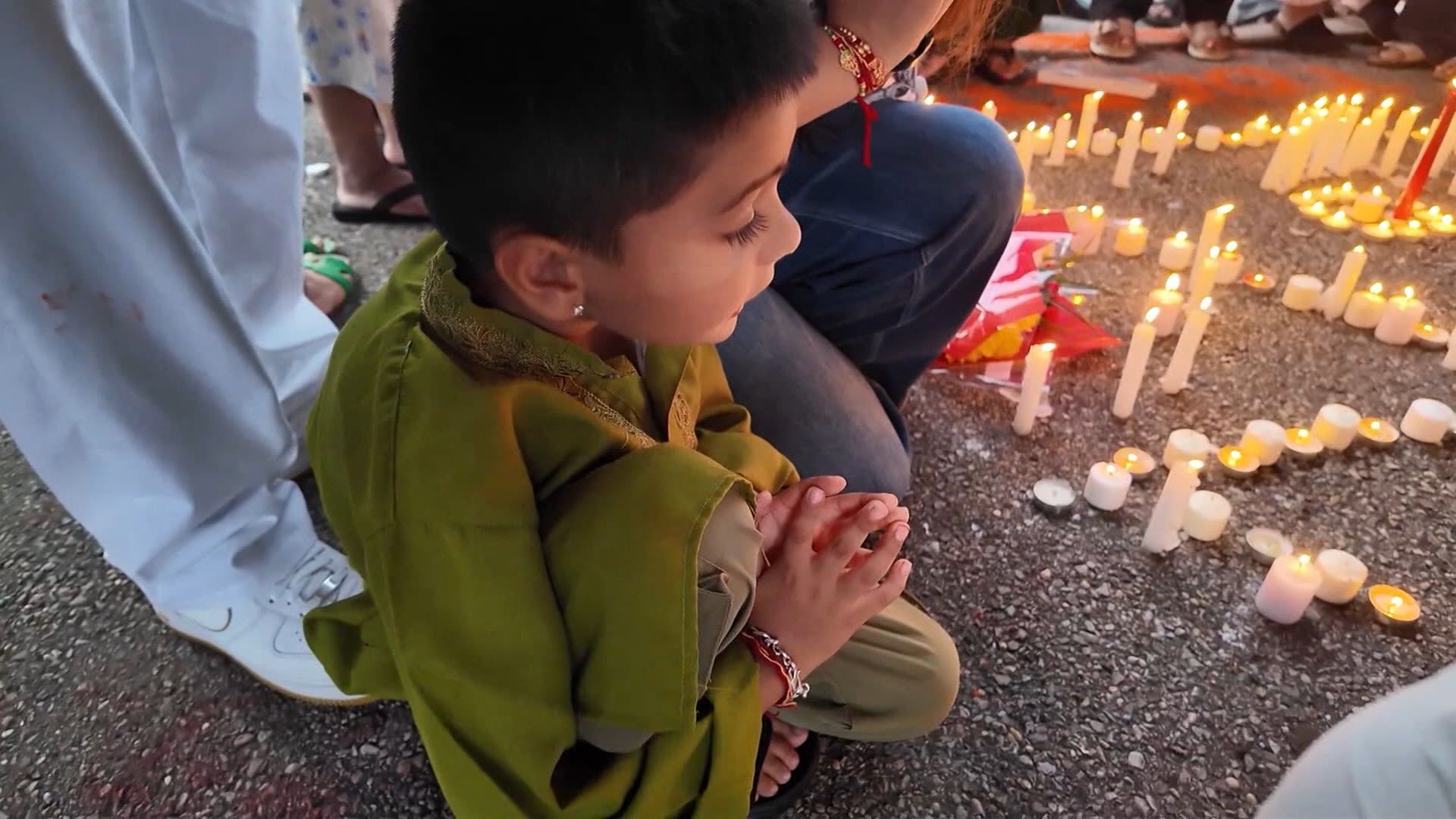
Members of the Nepali community on Long Island held a vigil Friday for their loved ones.
0:12 • NEWS 12 LONG ISLAND
The Nepali community in Long Island, New York, came together to hold a vigil last night as they wait to hear news about missing friends and loved ones following catastrophic flooding along Nepal’s border with China.
“It’s very heartbreaking to all of us to see our fellow country people losing their lives and houses in the matter of a few minutes,” Myam Jiri, vice president of the Long Island Nepalese Society, told CNN affiliate News 12 Long Island.
Diwakar Pande, a Nepali community leader attending the vigil, who taught in Nepal, said he lost several people to the flooding, including three students and a neighbor.
“It is not a good moment, but we are sharing in our sorrow bravely together,” Rajan Gouelie, another member of the Long Island Nepalese Society, told News 12.
While it was an opportunity for the community to come together in their grief, the event also served as a fundraiser toward ongoing relief efforts for those impacted by the disaster, organizers said.
“In this difficult moment, we have to help Nepal get back to its feet,” Jiri said.
A newly-formed lake beside the site of catastrophic landslides in the Himalayas has shrunk, according to satellite imagery, after regional authorities sounded the alarm over the threat of fresh flooding.
Concerns over the lake triggered both China and Nepal to briefly pause rescue efforts yesterday.
But as of Saturday morning local time, the surface area of the barrier lake near the Nepal-China border decreased by about 5,000 square meters compared with the previous day, according to remote sensing imagery recorded by China’s Ministry of Water Resources.
That drop in volume indicated “slow water flow over the barrier dam,” the country’s state broadcaster CCTV reported, citing the ministry.
However, the size of second 14,000 square meter-lake discovered later this week has remained unchanged, CCTV said, adding that the probability of the area overflowing is “not very high, but it still needs to be continuously monitored.”
The two bodies of water are nestled just north of an area where hundreds of people were killed by colossal landslides on the Nepal-China border on Wednesday. Earlier yesterday, Nepali and Chinese officials were forced to pull emergency crews out after the first lake surfaced. By later in the day, the second lake had bulged — sparking fears of another lethal torrent.
Jiwan Jyoti, a US citizen, was traveling with Himalayan Glacier Adventure and Travel Company and has been listed by the group as missing.
The group had stopped in Timure, Nepal, before they were set to leave for a pilgrimage to Mount Kailash in Tibet, a sacred site for Hindus, Buddhists and others, Jyoti’s longtime friend Manmeet Singh Meet said.
Jyoti, a 50-year-old from Lexington, Massachusetts, called her family from breakfast on Wednesday as she was preparing to cross into Tibet.
Meet said the phone call ended “at around 8:40 a.m. local time in Nepal, and then I think around 8:45, this flash floods came, and then our world turned upside down.”
He later heard that the hotel where Jyoti had been staying — and where her location was last recorded on the Find My iPhone app — was destroyed. Now Meet said he is losing hope that his best friend of 15 years will be found alive.
“She was essentially almost in the epicenter over there,” Meet said.